
In Russia, you can verify the authenticity of jewelry by the presence of two hallmarks: the stamp of the state assay inspectorate and the manufacturer's mark, known as the maker's mark. Manufacturers receive it under Russian Government Resolution No. 1127 of October 21, 2015, “On Approval of the Rules for Registration and Production of Maker's Marks and for the Application and Destruction of Their Impressions.”
The maker’s mark and the hallmark on jewelry are mandatory attributes of a piece, a special stamp. For example, on gold earrings The manufacturer's stamp is applied to the clasp or another element of the piece. It is the mark of the jewelry maker, applied by an individual entrepreneur or a legal entity to the pieces they have made. Of course, each country has its own requirements for hallmarking jewelry, but here we cover the rules in force for Russian manufacturers.
Contents
- How purity marks differ from maker's marks
- Can the maker's mark be missing
- Where the hallmarks are located
How does a hallmark differ from a name engraving?
A hallmark is stamped on all jewelry made of gold, silver and other precious metals. The mark is mandatory, because it confirms that the sale of any piece of jewelry is legal in the Russian Federation. In essence, it is a guarantee that what you have is not some "counterfeit" but a completely legal piece.
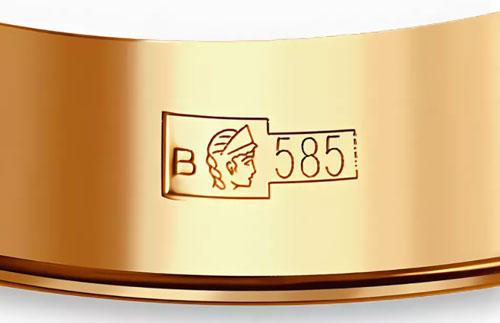
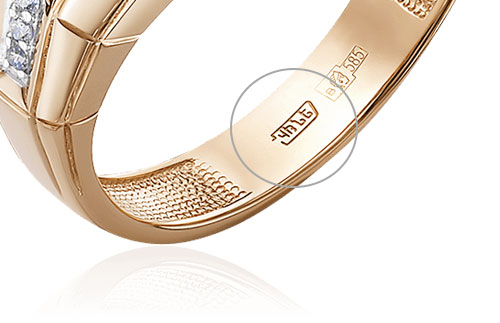
Visually, this karat consists of several parts:
- A woman's head in a kokoshnik, looking to the right.
- The state assay inspectorate code (a letter placed to the left of the main image, a head in a kokoshnik);
- The number placed next to the main image indicates the content of precious metal in the piece (this is what is called the metal's "fineness"). For example, jewelry gold comes in 500, 585 and 750 fineness. There is also 999 gold, but it is pure metal, from which bank bars are cast.
All elements of this stamp are enclosed in a certain outline, and its type tells you which precious metal the piece is made of. In particular, the hallmark on silver is enclosed in an oval with flattened sides, on gold in an outline that resembles a spade, and platinum pieces show a rectangle with beveled corners.
Another important part of jewelry marking is the maker's mark — a mandatory element that can be compared to a clothing label. It carries information about the manufacturer itself, i.e. who made the piece and when. For example, a gold bracelet.

The name inscription consists of 4 letters, each with its own meaning:
- The first letter. It indicates when the piece was assayed and most likely made. Each year has its own letter (for example, 2001 is the letter A, 2002 is the letter B, and so on). It should be noted that the Cyrillic letters Yo, Zh and Short I are missing from this list, because they are difficult to render on a piece. Accordingly, the year 2012 corresponds to the Cyrillic letter N, and so on in order.
- The second letter. It tells you which assay office hallmarked the piece. For example, the Cyrillic letter M stands for the State Assay Supervision Inspectorate for the city of Moscow and the Moscow region. But the letter code does not always match the first letter of the city or region where the piece was assayed, though it is easy to find online which code corresponds to a specific inspectorate.
- The third and fourth letters are those of the manufacturer itself. This code tells you when, where, and by whom a particular piece of jewelry was made.
The maker's mark is issued by the state assay inspectorate. Accordingly, to obtain one you need to register with the tax service and register your line of business.
Can the maker's mark be missing?
The presence of a maker's mark is a mandatory requirement confirming that the piece was made by a manufacturer registered with the tax service. In some cases, however, such marking may be absent.
The most obvious reason is that not all jewelers strive to work within the legal framework. An unwillingness to keep transparent accounts, make contributions to the Russian pension fund, and pay taxes pushes dishonest manufacturers into the "gray zone."
Another point is that a piece of jewelry may be imported into Russia. In that case the manufacturer's stamp will be absent, since the piece was made outside Russia. But the hallmark of the Russian State Assay Chamber of the established form must still be present, otherwise the piece is considered illegally imported into the Russian Federation.
Another possible reason for the absence of this mark is the making of exclusive pieces to order. Here we are talking more about a jeweler's collaboration with a particular trusted client who orders jewelry from him specifically. This is a story about a serious reputation: the client trusts the jeweler, and the jeweler trusts the client. But this is more of an exception to the rule, and it does not apply to jewelry you can buy at a boutique or an online store.
Rings with diamonds
Where are the hallmarks?
The hallmark is deliberately made small so as not to spoil the overall look of the piece. The stamp is placed in different spots, depending on the type of piece:
- bracelet – most often stamped on the link between the clasp and the rest of the piece (or on the ring);
- earrings – on a French wire or a post;
- rings, it is usually found on the inside.

The maker's mark is not just a mandatory requirement for manufacturers who trade in jewelry. It is also a source of important information for the buyer. For example, if you are buying jewelry in 2021, it is logical that the maker's mark will contain the Cyrillic letter Ch (corresponding to 2021) or Kh (2020). Yes, the piece may have been made somewhat earlier, but if you see a maker's mark for 2003 or 2004 on a chain or earrings, that is a serious reason for suspicion: was it taken from the nearest pawnshop, and is it being sold for the third time?
That is why we recommend that you buy jewelry only from reputable stores that provide all the necessary certificates and documents for their jewelry. This is the only way to protect yourself from fakes and keep your surprise from being spoiled.